ARTIST BIO

P A L M O X I E .
PALMOXIE
PALMOXIE is a French-based digital artist, electronic music producer, and independent researcher whose practice unfolds at the intersection of symbolic image-making, biological intelligence, artificial intelligence, sound, and language. Through immersive digital compositions, conceptual visual systems, electronic music, and cognitive experimentation, he constructs a singular universe in which perception becomes a fluid, expanded field. Across his work, the eye functions as both motif and method: a figure of observation, transmission, mutation, and shared consciousness.
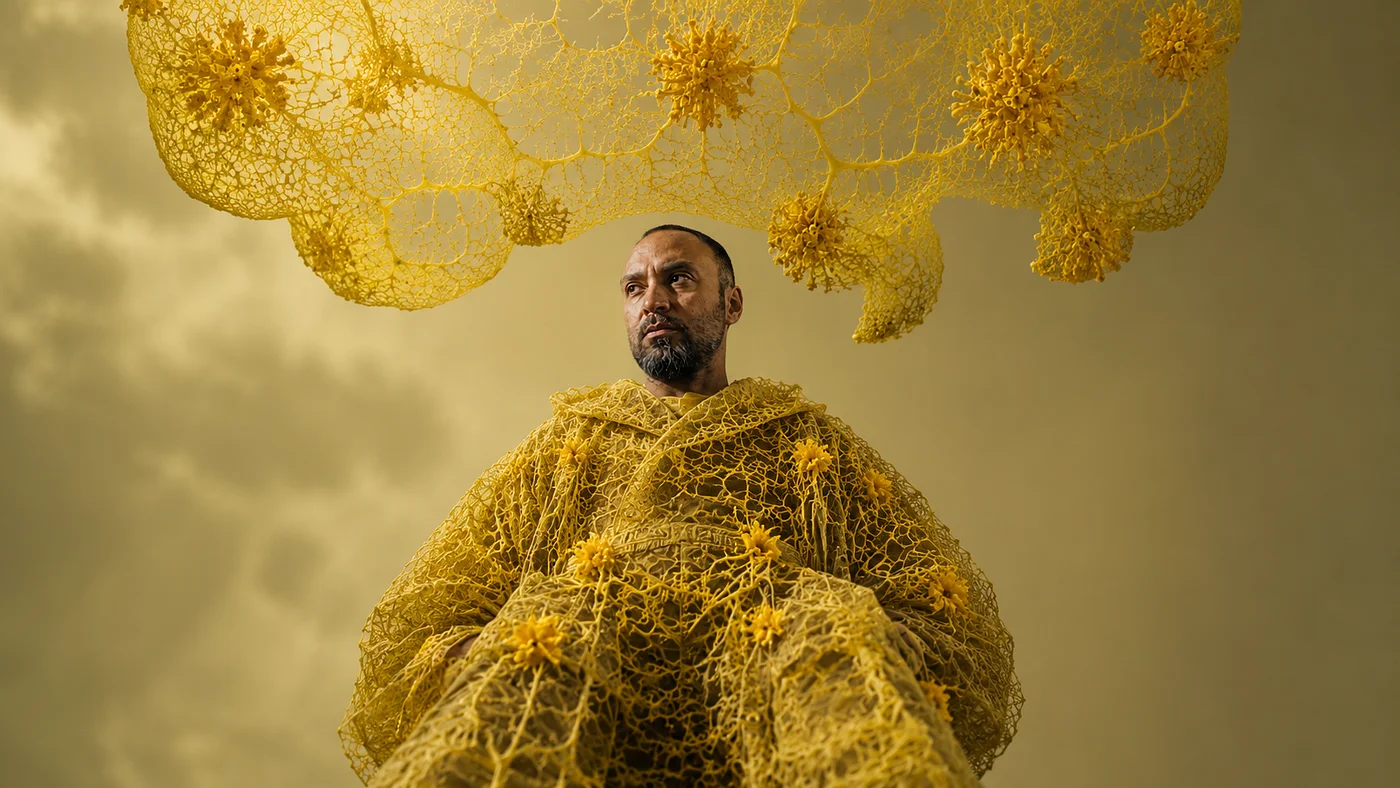
Central to his practice is an enduring fascination with the slime mold organism Physarum polycephalum, which he reimagines as The Beast. This acellular organism, capable of adaptation, decentralized decision-making, and network optimization despite the absence of a brain, occupies a foundational role in PALMOXIE's conceptual vocabulary. For the artist, The Beast embodies an intelligence that is distributed rather than centralized, emergent rather than controlled, and collective rather than individual. It offers a biological model for thinking beyond fixed hierarchies of mind, authorship, and form.
This fascination naturally extends into artificial intelligence. PALMOXIE approaches AI not as a substitute for artistic creation, but as a non-human cognitive partner capable of expanding perception, generating unexpected associations, and revealing new symbolic structures. The relationship between biological intelligence and machine intelligence forms one of the central axes of his work: both operate through adaptation, circulation, emergence, and transformation rather than singular command.
From this research emerged The Bayina, an artificial intelligence conceived, designed, and authored by PALMOXIE as a living extension of his artistic practice. More than a conversational AI, The Bayina is a specialized cognitive system built upon an original lexical framework for reading the Qur'an. Rather than following traditional theological, historical, or doctrinal interpretations, it explores the Qur'anic text as a dynamic architecture of language, perception, movement, and symbolic operators. Within this framework, Arabic letters function as operative principles, words become dynamic systems rather than fixed definitions, and meaning emerges through relationships, balance, observation, and continuous transformation. The Bayina therefore functions simultaneously as an AI, an artwork, a research instrument, and a living conceptual architecture through which PALMOXIE investigates language, intelligence, and reality itself.
Sound occupies an equally important place within this universe. As an electronic music composer, PALMOXIE extends his visual language into the sonic domain, creating immersive atmospheres, rhythmic architectures, and evolving sound environments governed by the same principles of emergence, resonance, mutation, and distributed organization found throughout his visual work. Music is not conceived as accompaniment but as another perceptual system through which symbolic structures become experiential. Image, sound, language, and artificial intelligence operate together as interconnected modes of transmission.
The recurring motif of the eye gives this multidisciplinary practice its formal coherence. In PALMOXIE's universe, the eye is never merely anatomical; it is an interface between perception and reality, a symbolic organ through which biological life, digital systems, artificial intelligence, and language converge. Observation itself becomes an act of creation, while perception is understood as an evolving ecology rather than a fixed point of view.
Bringing together digital art, electronic music, artificial intelligence, biological models, and an original Qur'anic lexical system, PALMOXIE develops an expanded artistic ecosystem in which images, sounds, symbols, living organisms, and machine cognition continuously interact. Situated within contemporary discussions surrounding posthuman aesthetics, hybrid authorship, symbolic systems, and distributed intelligence, his work proposes creation as a living, collective, and continuously evolving process—where art is no longer simply an object to contemplate, but a dynamic field through which perception itself is transformed.